How Old Were Babies Baptized in Church of England

H2o is poured on the caput of an infant held over the baptismal font of a Roman Catholic church
Infant baptism [1] [two] is the practice of baptising infants or immature children. Baby baptism can be assorted with what is called "believer's baptism" (or credobaptism, from the Latin word credo meaning "I believe"), which is the religious practice of baptising only individuals who personally confess faith in Jesus, therefore excluding underage children. Infant baptism is likewise called christening by some faith traditions.[3]
Most Christians vest to denominations that practice infant baptism.[ citation needed ] Branches of Christianity that practise infant baptism include Catholics,[4] Eastern[five] and Oriental Orthodox,[half dozen] and amid Protestants, several denominations: Anglicans,[7] Lutherans,[viii] Presbyterians,[nine] Congregationalists[10] and other Reformed denominations,[ citation needed ] Methodists,[xi] Nazarenes,[12] Moravians,[xiii] and United Protestants.[14] Opposition to infant baptism is termed "catabaptism".
Anniversary [edit]
The verbal details of the baptismal ceremony vary among Christian denominations. Many follow a prepared ceremony, called a rite or liturgy. In a typical ceremony, parents or godparents bring their kid to their congregation's priest or minister. The rite used would be the same as that denomination'south rite for adults, i.east., by pouring holy water (affusion) or by sprinkling water (aspersion). Eastern Orthodox and Eastern Cosmic traditions do total immersion and baptise babies in a font, and this practice is also the first method listed in the baptismal ritual of the Roman Catholic, although pouring is the standard exercise within the Latin branch of Catholicism. Catholic and Orthodox churches that practice this do not sprinkle. At the moment of baptism, the minister utters the words "I baptise you (or, 'The servant of God (name) is baptised') in the proper name of the Father, and of the Son, and of the Holy Spirit" (see Matthew 28:nineteen).[15] [ meliorate source needed ]
Although it is not required, many parents and godparents choose to dress the babe in a white gown called a christening gown for the baptism ceremony. Christening gowns often become treasured keepsakes that are used by many other children in the family and handed down from generation to generation. Traditionally, this gown is white or slightly off white and made with much lace, trim and intricate detail. In the past, a gown was used for both boys and girls; in the present twenty-four hours it has become more than common to dress children in a baptismal outfit. Also ordinarily fabricated of white material, the outfit consists of a romper with a belong or other accessories. These clothes are often kept as a memento after the ceremony.[ citation needed ]
It is a naval tradition to baptise children using the transport'due south bong every bit a baptismal font and to engrave the kid'due south name on the bell afterward.[xvi]
History [edit]
Antiquity [edit]
Scholars disagree on the date when infant baptism was get-go skillful. Some believe that 1st-century Christians did not practice it, noting the lack of any explicit show of infant baptism.[17] Others, noting the lack of any explicit evidence of exclusion of baby baptism, believe that they did, understanding biblical references to individuals "and [her] household" being baptised[18] as including young children.[19]
The primeval actress-biblical directions for baptism,[20] which occur in the Didache (c. 100),[21] are taken to be about baptism of adults, since they crave fasting by the person to exist baptised.[22] However, inscriptions dating back to the 2nd century which refer to young children as "children of God" may bespeak that Christians customarily baptised infants too.[23] The earliest reference to babe baptism was by Irenaeus (c. 130–202) in his work Against Heresies.[24] Due to its reference to Eleutherus as the electric current bishop of Rome, the work is usually dated c. 180.[25] Irenaeus speaks of children beingness "born again to God."[26] [27] This reference has been described as "obscure."[24] 3 passages by Origen (185–c. 254)[28] mention babe baptism equally traditional and customary.[29] While Tertullian writing c. 198–203 advises the postponement of baptism of little children and the unmarried, he mentions that it was customary to baptise infants, with sponsors speaking on their behalf.[30] The Apostolic Tradition, sometimes attributed to Hippolytus of Rome (died 235), describes how to perform the ceremony of baptism; it states that children were baptised get-go, and if whatsoever of them could non answer for themselves, their parents or someone else from their family was to answer for them.[31]
From at to the lowest degree the 3rd century onward Christians baptised infants as standard practice, although some preferred to postpone baptism until late in life, so equally to ensure forgiveness for all their preceding sins.[32]
Theology [edit]
Agreements among infant-baptizers [edit]
Based on their understanding of New Testament passages such as Colossians two:xi–12, Christians who baptize infants believe that infant baptism is the New Attestation counterpart to the Former Testament circumcision. In the Onetime Testament, all male converts to Judaism, male infants born to Jewish parents, and male servants were circumcised every bit ceremony of initiation into the Jewish community.[33] Christians who baptize infants believe that baptism has replaced Sometime Testament circumcision and is the religious ceremony of initiation into the Christian community.[34]
During the medieval and Reformation eras, babe baptism was seen as a manner to incorporate newborn babies into the secular community as well as inducting them into the Christian faith.[35] Due to loftier rates of infant mortality, it is of import to notation that canon law denied unbaptized infants a Christian burial in sacred ground.[36]
Teachings of Christian denominations practicing infant baptism [edit]

Different Christian denominations who practice infant baptism adhere different meanings to the sacrament and explain its efficacy in different means.
Roman Catholic Church building [edit]
The Roman Catholic Church considers baptism, fifty-fifty for an infant, and so important that "parents are obliged to see that their infants are baptized within the outset few weeks" and, "if the babe is in danger of decease, it is to be baptized without whatever filibuster."[37] It declares: "The practise of infant Baptism is an immemorial tradition of the Church. There is explicit testimony to this practise from the 2d century on, and it is quite possible that, from the commencement of the apostolic preaching, when whole 'households' received baptism, infants may also have been baptized".[38] It notes that "when the first straight evidence of infant Baptism appears in the second century, it is never presented as an innovation", that second-century Irenaeus[39] treated baptism of infants every bit a matter of course, and that, "at a Synod of African Bishops, St. Cyprian stated that 'God's mercy and grace should non be refused to anyone built-in', and the Synod, recalling that 'all homo beings' are 'equal', whatever be 'their size or age', declared it lawful to baptize children 'by the second or third 24-hour interval after their nascence'".[40] In the 17th and 18th centuries, many infants were baptized on the 24-hour interval of their birth as in the cases of Francoise-Athenais, Marquise de Montespan, Jeanne Du Barry and Marie Anne de Cupis de Camargo. Infant baptism is seen as showing very conspicuously that salvation is an unmerited favour from God, not the fruit of human being endeavor.[41] "Built-in with a fallen human nature and tainted by original sin, children also have need of the new nascency in Baptism to be freed from the power of darkness and brought into the realm of the liberty of the children of God, to which all men are called . . . The Church and the parents would deny a kid the priceless grace of condign a kid of God were they not to confer Baptism shortly after birth".[42]
The Church has no dogmatic official teaching regarding the fate of infants who dice without baptism, and theologians of the Church hold various views (in item, many have asserted that they become to Limbo). "The Church entrusts these infants to the mercy of God."[43]
The Congregation for the Doctrine of the Faith issued on 20 October 1980 an instruction on infant baptism, whose purpose was "to recollect the main points of doctrine in this field which justify the Church building's constant practice downward the centuries and demonstrate its permanent value in spite of the difficulties raised today". The document then indicated some general guidelines for pastoral action.[44]
The document recalled that baby baptism has long been considered of apostolic origin and that the first direct testify of its practice, dating from the 2nd century, does not nowadays information technology every bit an innovation. It so responded to objections that baptism should follow religion, that the person baptized should consciously receive the grace of the sacrament, that the person should freely accept baptism, that infant baptism is unsuitable in a social club marked by instability of values and conflicts of ideas, and that the practice is inimical to a missionary outlook on the part of the Church.[45]
The educational activity then gave guidelines for pastoral practice, based on ii principles. The major principle is that baptism, equally the sign and ways of God'due south beloved that precedes any activity on our part and that frees from original sin and communicates divine life, must not exist delayed. The subordinate principle is that assurances must be given that the gift thus granted tin grow past authentic education in the faith and Christian life. If these assurances are not actually serious, there tin be grounds for delaying baptism. If they are certainly absent, the sacrament should fifty-fifty be refused.[46]
Accordingly, the rules for involvement on the part of practicing Christian parents must be supplemented with other considerations in the example of "families with little faith or non-Christian families". If these asking that a kid of theirs exist baptized, there must be assurances that the kid will be given the benefit of the Christian upbringing required by the sacrament. Examples of such assurances are "the pick of godparents who will have sincere intendance of the child, or the support of the community". If there is satisfactory assurance, i.e., "any pledge giving a well-founded hope for the Christian upbringing of the children", then "the priest cannot refuse to celebrate the sacrament without delay, as in the case of children of Christian families". If there is insufficient assurance, "it will exist prudent to delay baptism", while keeping contact with the parents in the promise of securing the required conditions for celebrating the sacrament. Equally a last resort, enrollment of the child in a course of catechetical instruction on reaching school age can be offered in lieu of immediate celebration of baptism.[47] The possibility of delaying infant baptism in the case of non practicing or non assertive parents raises a number of questions. How can we discern that in that location are guarantees of an accurate Christian education? Can a priest propose an alternative commemoration in the instance where baptism is to be delayed? In some German speaking countries, bishops have opened the door to a "ii step baptism", i.e. 2 celebrations separated by a time of evangelization of the parents. In this case, the rite of baptism itself is to exist performed in the second commemoration, when parents are supposed to have enough maturity to heighten the child in the Cosmic faith.[48]
The Catechism of the Catholic Church building states: "Since Baptism signifies liberation from sin and from its instigator the devil, one or more exorcisms are pronounced over the candidate".[49] In the Roman Rite, the wording of the prayer of exorcism is: "Almighty and ever-living God, you sent your only Son into the world to cast out the power of Satan, spirit of evil, to rescue man from the kingdom of darkness and bring him into the splendour of your kingdom of low-cal. We pray for this child: set him (her) free from original sin, make him (her) a temple of your glory, and send your Holy Spirit to dwell with him (her). Through Christ our Lord."[50]
Eastern Orthodoxy, Oriental Orthodoxy and the Church of the Due east [edit]
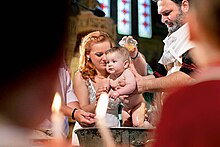
The Eastern Orthodox Church, Oriental Orthodoxy and the Assyrian Church of the Eastward too insist on the demand to accept infants baptized as soon every bit is practicable subsequently birth. Like to the Roman Catholic Church building, they teach that baptism is not merely a symbol just actually conveys grace. Baptism is a sacrament because it is an "instrument" instituted by Jesus Christ to impart grace to its recipients. Infants are traditionally baptized on the eighth day,[51] recalling the biblical injunction to circumcise on the 8th day. However, this is not mandatory. In many of these churches, the Sacred Mystery of Chrismation (Confirmation) is administered by the priest immediately after baptism. Holy Communion, in the course of consecrated wine and breadstuff, is also given to infants later on they are baptized.[52]
Lutheran Churches [edit]

Lutherans do babe baptism because they believe that God mandates it through the teaching of Jesus Christ, "Go and brand disciples of all nations, baptizing them in the name of the Father and of the Son and of the Holy Spirit",[53] in which Jesus does not prepare any age limit:
The command is general. It includes infants, women, men, and teenagers, even though none of these groups is specifically named. Each of these groups is included in "all nations."[54]
They also cite other biblical passages such as Mark 10:thirteen-15, Marking 16:16, John 3:iii-vii and Acts 2:38-39[55] in back up of their position. For example, in the Acts of the Apostles Saint Peter'due south teachings on Pentecost included children in the hope of Baptism, "Repent and be baptized, every one of you, in the name of Jesus Christ for the forgiveness of your sins. And you will receive the souvenir of the Holy Spirit. The promise is for you and your children".[54]
For them baptism is a "means of grace" through which God creates and strengthens "saving faith"[56] [57] as the "washing of regeneration"[58] in which people are reborn (John 3:iii–seven): "baptismal regeneration". Since the creation of faith is exclusively God's work, information technology does non depend on the actions of the ane baptised, whether infant or adult. Even though baptized infants cannot articulate that faith, Lutherans believe that it is present however.[59] Because it is faith lone that receives these divine gifts, Lutherans confess that baptism "works forgiveness of sins, delivers from death and the devil, and gives eternal salvation to all who believe this, as the words and promises of God declare".[threescore] In the special section on infant baptism in his Large Catechism Luther argues that infant baptism is God-pleasing considering persons so baptized were reborn and sanctified by the Holy Spirit.[61]
Lutherans believe that babies are conceived and born sinful[62] and therefore need to be born again to enter the kingdom of heaven.[63] Through Baptism, the Holy Spirit works rebirth,[64] creates faith in them, and saves them.[65] Although some deny the possibility of infant faith, the Bible clearly teaches that babies tin can believe.[66] [54]
Methodist Churches [edit]

In the Methodist Churches, baptism is a sacrament of initiation into the visible Church.[67] Wesleyan covenant theology further teaches that baptism is a sign and a seal of the covenant of grace:[68]
Of this great new-covenant blessing, baptism was therefore eminently the sign; and it represented "the pouring out" of the Spirit, "the descending" of the Spirit, the "falling" of the Spirit "upon men," by the mode in which it was administered, the pouring of water from higher up upon the subjects baptized. Every bit a seal, also, or confirming sign, baptism answers to circumcision.[68]
Baby baptism, in Methodism, is celebrated as "an acceptance of the prevenient grace of God and equally a confession on the part of the church building of its responsibility for children in general and for every child in particular."[69] [11] Methodists teach that people receive justifying grace, which is integral to conservancy, after they apologize and personally accept Jesus as Saviour.[70] [71] Many Methodist denominations, such as the Costless Methodist Church building and Allegheny Wesleyan Methodist Connectedness, practice infant baptism for families who want it for their children, but provide a rite for child dedication for those who accept a preference for credobaptism simply later on their kid has made a personal credence of Jesus every bit his/her saviour.[71] [72]
Presbyterian, Congregational and Reformed Churches [edit]
Presbyterian, Congregational and Reformed Christians believe that baptism, whether of infants or adults, is a "sign and seal of the covenant of grace", and that baptism admits the party baptized into the visible church.[73] Being a member of the visible church does not guarantee conservancy; though information technology does provide the child with many benefits, including that of 1'due south particular congregation consenting to assist in the raising of that kid in "the way he should become, (so that) when he is erstwhile he will not plough from it". Elect infants (those predestined for conservancy) who die in infancy are by organized religion considered regenerate on the basis of God'due south covenant promises in the covenant of grace.[74]
Presbyterian, Congregational and many Reformed Christians run into infant baptism as the New Testament grade of circumcision in the Jewish covenant.[75] Circumcision did not create religion in the 8-day-old Jewish boy. It merely marked him every bit a member of God'south covenant people Israel. As well, baptism doesn't create faith; information technology is a sign of membership in the visible covenant community.[76]
Presbyterian, Congregational and Reformed Christians consider children of professing Christians to be members of the visible Church (the covenant customs). They also consider them to be full members of the local congregation where their parents are members and members of the universal Church (the set of all true believers who make upwards the invisible church) unless and until they bear witness otherwise. Baptism is the mark of membership in the covenant of grace and in the universal church, although regeneration is not inseparably connected with baptism.[77]
Contrasts between infant and adult baptism [edit]
Christians disagree about baby baptism because they disagree about the nature of faith, the function of baptism, the ways of salvation, the nature of grace, and the function of the sacraments. Pedobaptism and credobaptism are positions which bubble upwards from theological views at a more fundamental level of one's theological arrangement.
- If baptism is a sign that a person is a member of God'southward covenant customs, and if the children of believers are members of that community, information technology follows that the children of believers should receive the sign that they are members of God's covenant community by being baptized, as an infant is entitled to a passport that indicates the kid as a member of a particular country.[78]
- Believers and the children of believers become members of God's covenant community (or church building) through baptism.[79]
- It is believed by some Christians that in the heart of a baptized child, faith as a gift or grace from God, every bit distinct from an act by the person, is made present.[eighty]
- It is believed by some Christians that baptism is not but a symbol and that it has a existent effect, carrying divine grace.[81]
Arguments for babe baptism [edit]
Christians who practice infant baptism do not completely agree on the reasons for doing so, and offer dissimilar reasons in support of the practice. Among the arguments fabricated in support of the exercise are:
- Analogy with circumcision: Some Christians posit an illustration of baptism to circumcision, pointing to children, since the historic Israelite awarding of circumcision was to infants, non to developed converts, of which there were few. Covenant theology identifies baptism less as a statement of faith than equally an assumption of identity; that is to say that infant baptism is a sign of covenantal inclusion.[82] Bold that what God instituted in the Old Attestation continues unless the New Attestation specifically abrogates information technology, including infants in the giving of the sign of the covenant must continue in the New Covenant. It is particularly then if the practice is an important one.[83]
- Jesus' affirmation: According to Luke eighteen:fifteen-17, when parents brought their babies to Jesus, the disciples tried to prevent them from coming. Jesus becomes indignant and says, "Allow the little children come to me, and do not hinder them, for the kingdom of God belongs to such as these." This seems to confirm that infants can accept a personal relationship with Jesus just as parents can have a personal relationship with their babies. More chiefly, Jesus confirms that babies of believers belong to the kingdom of God. In other words, babies of believers are counted as believers, not unbelievers. Therefore, Jesus specifically instructs not to hinder them.[84]
- Peter's speech: According to the Volume of Acts, "Peter replied, 'Repent and exist baptized, every one of you, in the name of Jesus Christ for the forgiveness of your sins. And you volition receive the gift of the Holy Spirit. The promise is for you and your children and for all who are far off—for all whom the Lord our God will call.'" (Acts ii:38–39, NIV–UK, accent added)[85] Some churches inside The United Methodist Church argue that the phrase "every one of you" recalls the use of the same phrase in Deuteronomy 29:10–12,[86] where in that location is explicit mention of the "piddling ones" present; and it takes the phrase "and your children" to mean that Peter included children in the covenant community.[87]
- Early Christian do: Several early on Church Fathers seem to have taught that infant baptism is proper; Origen states that the practice of baptising infants is of apostolic origin.[88]
Arguments against infant baptism [edit]
- Infants cannot repent or believe: Baptism in Scripture ever has the prerequisite of repentance and faith, which are impossible for an infant.[89]
- Baptism merely for believers: The Lord's Supper and Baptism are both sacraments or ordinances and are the aforementioned sign and seal, since the Lord'southward Supper may not be given to unbelievers, neither should baptism.[ninety] [ commendation needed ]
- No scriptural instances: In that location are no explicit instances of babe baptism in the scripture[89]
Denominations and religious groups opposed to babe baptism [edit]
Trinitarian Christian denominations that oppose infant baptism include the International Christian Church, all Baptist and Anabaptist traditions and denominations, Pentecostals, Associates of God and more than. [91]
Several nontrinitarian religious groups also oppose babe baptism, including Oneness Pentecostals, Christadelphians, Jehovah'south Witnesses, United Church of God, and The Church of Jesus Christ of Latter-day Saints.[92]
B.R. White describes the motivations backside persecution of the Anabaptists during the Reformation equally follows:
Other Christians saw the baptism of each new-born baby into the secular parish community and close links betwixt church and state as the divinely-ordained means of holding lodge together. Hence many other Christians saw the Anabaptists as subversive of all order. Consequently, from the earliest days, they were sharply persecuted and leaders were soon executed.[93]
The Church of Jesus Christ of Latter-day Saints (LDS Church) completely rejects infant baptism.[92] Little children are considered both born without sin[94] and incapable of committing sin.[95] They have no need of baptism until age viii,[96] when they can begin to learn to discern right from incorrect, and are thus accountable to God for their ain deportment.[97] Notwithstanding, the LDS Church performs a non-saving ordinance to proper name and bless children, customarily performed on infants.[98]
Confirmation [edit]
For Roman Catholic and Methodist Christians, Confirmation "strengthens" (the original meaning of the word "confirm")[99] [100] the grace of Baptism, by conferring an increase and deepening of that grace.[101] [100]
In Eastern Christianity, including the Eastern Catholic Churches, the sacrament of Confirmation is conferred immediately after baptism, and in that location is no renewal of baptismal promises. In the Latin-Rite (i.e. Western) Catholic Church, the sacrament is to be conferred at about the age of discretion (by and large taken to be about 7), unless the Episcopal Conference has decided on a different age, or there is danger of death or, in the judgement of the minister, a grave reason suggests otherwise (catechism 891 of the Code of Canon Police force). The renewal of baptismal promises by those receiving the sacrament in the Western Catholic Church is incidental to the rite and not essentially dissimilar from the solemn renewal of their baptismal promises that is asked of all members of this Church each twelvemonth at the Easter Vigil service. But in French-speaking countries has in that location been a development of ceremonies, quite distinct from the sacrament of Confirmation, for young Catholics to profess their faith publicly, in line with their age.[102]
Within The Church building of Jesus Christ of Latter-mean solar day Saints, confirmation or "the laying on of hands" is an essential function of the baptismal ordinance, and to receive baptism without confirmation is to leave the ordinance incomplete.[103] Confirmation is the conferring of the gift of the Holy Ghost as a constant companion.[104] To confirm means to "make more than sure" and the ordinance of confirmation stands every bit a witness of the individual becoming a fellow member of the LDS Church and not just an credence of Jesus.[103]
Opposition to infant baptism [edit]
According to legal professor and old Irish president Mary McAleese, every bit outlined in her doctoral thesis, infant baptism amounts to "enforced membership of the Catholic Church", which violates fundamental rights of children. These "baby conscripts (...) are held to lifelong obligations of obedience" without their understanding or consent. "Parents can guide and directly [their children] only they can't impose, and what the church has failed to practise is to recognise that there has to be a bespeak at which our young people, as adults who have been baptised into the church and raised in the organized religion, take the chance to say 'I validate this' or 'I repudiate this'. Yous and I know, we live at present in times where nosotros have the right to freedom of conscience, freedom of belief, freedom of stance, freedom of religion and freedom to change religion. The Catholic Church all the same has to fully encompass that thinking."[105]
Controversies [edit]
Baptisms have sometimes pb to injuries, or deaths, such as drowning deaths, to babies.[106] [107] In some instances information technology has served every bit an opportunity to revise practices.[108]
Yazidi baptism [edit]
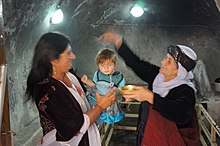
In Yazidism, children are baptised at birth and circumcision is not required, but is practised by some due to regional community.[109] The Yazidi baptism is called Mor kirin (literally: 'to seal'). Traditionally, Yazidi children are baptised at nativity with h2o from the Kaniya Sipî ('White Spring') at Lalish. Information technology involves pouring holy water from the bound on the child'south head three times.[110] [111]
See too [edit]
- Anabaptists
- Baptism
- Believer's baptism
- Sacraments of initiation
- Infant communion
- William Wall (theologian)
- Aqiqah
References [edit]
- ^ "The Baptism Service". Church building of England. Archived from the original on 16 July 2007. Retrieved eight June 2007.
Q. What'south the difference between a baptism and a christening?
A. None, they are just different words for the aforementioned thing. - ^ "Can I accept my infant christened?". United Methodist Church. Archived from the original on 7 June 2011. Retrieved eight June 2007.
Christening is non a separate or different service. It is the aforementioned thing as baptism.
- ^ b777 (12 June 2009). "What is credobaptism?". carm.org . Retrieved 27 July 2020.
- ^ "Catechism of the Catholic Church, How is the Sacrament of Baptism Celebrated?". The Holy See . Retrieved xi February 2021.
- ^ "Infant Baptism: What the Church building Believes | Antiochian Orthodox Christian Archdiocese". ww1.antiochian.org . Retrieved xix June 2021.
- ^ "Coptic Orthodox Diocese of the Southern United States - Q&A". www.suscopts.org . Retrieved 19 June 2021.
- ^ Goebel, Greg (six March 2013). "Baby Baptism: Why practise Anglicans Baptize Babies?". Anglican Compass . Retrieved 19 June 2021.
- ^ "Doctrine - Frequently Asked Questions - The Lutheran Church building—Missouri Synod". www.lcms.org . Retrieved 19 June 2021.
- ^ "Why Does the Orthodox Presbyterian Church Baptize Infants?: The Orthodox Presbyterian Church". opc.org . Retrieved 19 June 2021.
- ^ "About Baptism". United Church of Christ . Retrieved 19 June 2021.
- ^ a b Manns, Peter; Meyer, Harding (1984). Luther's Ecumenical Significance: An Interconfessional Consultation. Fortress Press. p. 141. ISBN978-0-8006-1747-9.
When mod Methodists expound baby baptism, they call up first of " prevenient grace", for which infant baptism is said to be an effective, or at least a useful, sign.
- ^ "Baptism of Infants".
- ^ "The Sacrament of Baptism | Moravian Church in America". Retrieved 19 June 2021.
- ^ "Baptism and Communion". United Church building of Canada. Retrieved 28 March 2021.
- ^ Ljthriepland (3 March 2019). "In the name of the begetter, son and the holy spirit. Matthew 28-19". Follow in Truth . Retrieved 27 July 2020.
- ^ MacFarlane, John (2020). "The Tradition of Naval Baptism As Carried Out at HMCS Cataraqui". world wide web.nauticapedia.ca . Retrieved 4 April 2021.
{{cite web}}: CS1 maint: url-status (link) - ^ Stanley J. Grenz, Theology for the Community of God (G Rapids, MI: Eerdmans, 2000), 528
- ^ Acts 16:15, Acts sixteen:31–33, 1 Corinthians i:16
- ^ John Calvin, Institutes of the Christian Religion Archived 17 Feb 2007 at the Wayback Car; Gregg Strawbridge, Ph.D.; Jordan Bajis Archived 19 April 2008 at the Wayback Machine,
- ^ "the Didache, the primeval surviving 'pastoral manual' of the Christian church" (Fuller Seminary Bookstore Archived 27 September 2007 at the Wayback Machine)
- ^ "Chapter 7, "Concerning Baptism."
- ^ "Before the baptism let the baptizer fast, and the baptized, and whoever else can; but yous shall order the baptized to fast one or two days before" (Didache, seven)
- ^ The 1980 Instruction of the Congregation for the Doctrine of the Religion states that "Many inscriptions from equally early as the 2nd century give little children the title of 'children of God', a title given merely to the baptised, or explicitly mention that they were baptised: cf., for example, Corpus Inscriptionum Graecarum, 9727, 9801, 9817; E. Diehl, Inscriptiones Latinae Christianae Veteres (Berlin 1961), nos. 1523(3), 4429A."
- ^ a b Walker, W. (1919). A History of the Christian Church. New York: Charles Scribner'southward Sons. p.95
- ^ Schaff, Philip (2001) [c. 1885] "Introductory Note to Irenæus Confronting Heresies", Ante-Nicene Fathers, Book I, Against Heresies, William B. Eerdmans Publishing Visitor.
- ^ "For He came to save all through ways of Himself—all, I say, who through Him are born again to God—infants, and children, and boys, and youths, and old men. He therefore passed through every age, becoming an infant for infants, thus sanctifying infants; a kid for children, thus sanctifying those who are of this age, being at the same fourth dimension made to them an example of piety, righteousness, and submission; a youth for youths, becoming an example to youths, and thus sanctifying them for the Lord. So likewise He was an erstwhile homo for erstwhile men, that He might be a perfect Master for all, not merely equally respects the setting forth of the truth, but also every bit regards age, sanctifying at the same time the aged besides, and condign an instance to them likewise. And so, at last, He came on to expiry itself, that He might be "the first-built-in from the dead, that in all things He might accept the pre-eminence," the Prince of life, existing before all, and going before all." Irenaeus of Lyons. (1885). Irenæus against Heresies. In A. Roberts, J. Donaldson, & A. C. Coxe (Eds.), The Ante-Nicene Fathers: The Apostolic Fathers with Justin Martyr and Irenaeus (Vol. 1, p. 391). Buffalo, NY: Christian Literature Visitor.
- ^ Against Hereses Archived 20 May 2008 at the Wayback Automobile, 2.22.four.
- ^ The 3 passages identified by scholars are Homilies on Leviticus 8.three.11; Commentary on Romans 5.ix; and Homily on Luke 14.five. They are mentioned, for instance, in the following sites: i, 2, 3 Archived 19 Apr 2008 at the Wayback Machine four Archived 16 November 2016 at the Wayback Motorcar, 5, six Archived 16 November 2016 at the Wayback Machine and, of class, in the sites that give the full texts of Origen on Leviticus and Luke.
- ^ The showtime passage cited has: "Baptism according to the practice of the Church building is given even to infants"; the second has: "The Church had a tradition from the Apostles, to give baptism even to infants"; the 3rd has: "Infants are baptised for the remission of sins . . . That is the reason why infants too are baptised".
- ^ "The delay of baptism is preferable; principally, nonetheless, in the example of fiddling children. For why is information technology necessary . . . that the sponsors besides should be thrust into danger? . . . For no less cause must the unwedded too be deferred—in whom the basis of temptation is prepared, alike in such as never were wedded by means of their maturity, and in the widowed by means of their freedom—until they either marry, or else be more fully strengthened for continence" ([1] xviii).
- ^ "The children shall be baptised first. All of the children who can answer for themselves, let them answer. If there are any children who cannot respond for themselves, let their parents answer for them, or someone else from their family. After this, the men will be baptised. Finally, the women" (The Apostolic Tradition of Hippolytus of Rome Archived 8 July 2011 at the Wayback Motorcar 21.4–five).
- ^ "Infant Baptism: Scriptural and Reasonable". Archived from the original on nine May 2008. ; What does the Bible teach most the discipline of baptising of infants? past Don Matzat Archived 11 March 2008 at the Wayback Motorcar; Babe Baptism in Early Church History Archived 8 March 2008 at the Wayback Machine; Christian Heresies of the Sixteenth Century
- ^ Genesis 17:10–fourteen.
- ^ Salter, Martin (April 2010). "Does Baptism Supercede Circumcision? An Examination of the Human relationship between Circumcision and Baptism in Colossians" (PDF). Themelios: 15–29.
- ^ White, BR, Handbook to Christian Conventionalities, Eerdman's, p. 443 .
- ^ Crow, Madison; Zori, Colleen; Zori, Davide (17 December 2020). "Doctrinal and Physical Marginality in Christian Death: The Burial of Unbaptized Infants in Medieval Italy". Religions. xi (12): ane. doi:10.3390/rel11120678.
- ^ Lawmaking of Catechism Law, catechism 867.
- ^ "Catechism of the Catholic Church - Function ii SECTION 2 CHAPTER 1 Commodity 1". www.scborromeo.org.
- ^ "ANF01. The Churchly Fathers with Justin Martyr and Irenaeus - Christian Classics Ethereal Library". www.ccel.org.
- ^ Congregation for the Doctrine of the Organized religion. "Instruction on Baby Baptism". world wide web.catholicculture.org.
- ^ "The sheer gratuitousness of the grace of salvation is especially manifest in infant Baptism" (Canon of the Cosmic Church, 1250).
- ^ "Catechism of the Catholic Church - Office 2 Department 2 Affiliate 1 Commodity i". www.scborromeo.org.
- ^ "Catechism". world wide web.usccb.org.
- ^ Instruction on Babe Baptism Archived 20 July 2009 at the Wayback Machine
- ^ Instruction, Part II
- ^ Instruction, 28
- ^ Instruction, 30–31
- ^ Jacobs, Bruno (2019). Le baptême des petits enfants dans une société déchristianisée. Switzerland: Parole et Silence. pp. 210–231, 433–515.
- ^ "Catechism of the Catholic Church - IntraText". www.vatican.va.
- ^ Rite of Baptism of Children, 86
- ^ John Henry Parker; et al. (1844). "The Epistles of S. Cyprian, with the Council of Carthage, on the Baptism". Oxford, London. Retrieved 12 December 2014.
- ^ Ware, Bishop Kallistos (Timothy) (1964). The Orthodox Church. New York: Penguin Books. p. 284.
- ^ Matthew 28:nineteen
- ^ a b c "Sacrament of Holy Baptism – Circumcision". WELS Topical Q&A. Wisconsin Evangelical Lutheran Synod. Archived from the original on two January 2008. Retrieved 29 Jan 2015.
- ^ Marking 10:13–xv, Marking 16:sixteen, John 3:3–7 and Acts 2:38–39
- ^ "Infant Baptism". WELS Topical Q&A. Wisconsin Evangelical Lutheran Synod. Archived from the original on 2 January 2008. Retrieved 29 January 2015.
In baptism, however, nosotros exercise not do something for God, rather he does something for us and in us. He works to either create or to strengthen faith. It is truthful that neither baptism nor the annunciation of the gospel will do good anyone apart from faith. All the same, through the proclamation of the gospel and through baptism the Holy Spirit works faith. The means of grace have the power to create the faith they crave.
- ^ Colossians 2:11–12, quoted by Otto, Joel D., Live in Christ Archived 29 April 2014 at the Wayback Motorcar, pp 9–11
- ^ Titus iii:5
- ^ Encounter "Baptism and Its Purpose" Archived 6 February 2009 at the Wayback Car
- ^ "The Modest Canon - Volume of Concord". world wide web.bookofconcord.org. eight November 2019.
- ^ "See "Luther'southward Large Catechism" subsection "Of Infant Baptism"". 29 October 2020.
- ^ Psalm 51:5
- ^ John 3:5–vi
- ^ Titus 3:4–7
- ^ 1 Peter 3:21
- ^ Marker 9:42, Luke 18:15–17
- ^ Stuart, George Rutledge; Chappell, Edwin Barfield (1922). What Every Methodist Should Know. Lamar & Barton. p. 83.
- ^ a b Summers, Thomas Osmond (1857). Methodist Pamphlets for the People. E. Stevenson & F. A. Owen for the M. East. Church, South. p. 18.
- ^ Methodist Review, Volume 101. G. Lane & P. B. Sandford. 1918. p. 464.
- ^ "God's Preparing, Accepting, and Sustaining Grace". The United Methodist Church GBGM. Archived from the original on ix January 2008. Retrieved ii August 2007.
- ^ a b "Baptism and Dedication". Gratuitous Methodist Church. iii Dec 2008.
When they baptize babies, pastors should make sure that their prayers include clear requests that God will bring the children to a personal faith that "owns" what the parents are promising at a time when the children (who "belong" from day one) cannot act for themselves. And when they dedicate children, pastors should brand sure that their prayers include clear gratitude to God for the fact that he is already at work in the life of that kid, who already "belongs" in the Christian community. Hither's what must be stressed: whether at the fourth dimension of baptism (in the adult baptism tradition) or at the time of confirmation when the vows made earlier by the parents are personally "endemic" (in the baby baptism tradition), it is religion in Jesus (dependent trust, not mere cognitive affirmation) that is crucial. Paul goes and so far as to say that without faith and obedience, the one-time rite of circumcision has no value (Romans 2:25). The aforementioned is true of baptism. With either rite, clear evangelistic follow-through is crucial.
- ^ The Discipline of the Allegheny Wesleyan Methodist Connection (Original Allegheny Briefing). Salem: Allegheny Wesleyan Methodist Connectedness. 2014. pp. 140–146.
- ^ Westminster Confession of Faith, Affiliate 28, Section one.
- ^ Westminster Confession of Faith, Chapter 10, Section 3.
- ^ Joshua 24:15
- ^ DeYoung, Kevin. "A Cursory Defense force of Babe Baptism". The Gospel Coalition . Retrieved xi October 2019.
- ^ Westminster Confession, Chapter 28, Section ane and especially department iii. Baptized people are considered part of the covenant of grace by faith unless they bear witness otherwise past committing betrayment.
- ^ Calvin asked: "If the children of believers are partakers of the covenant without the help of understanding, there is no reason why they should be barred from the sign but because they cannot swear to the provisions of the covenant" (Inst. 4, 16, 24, quoted in John Calvin: Infant Baptism)
- ^ "If baptism was demanded of the Jews as a prerequisite of church building membership, we may reasonably conclude that the Gentiles were non admitted to the privilege except on the same condition" (Baptism a Status of Church Membership).
- ^ "When an infant is baptized God creates faith in the heart of that infant. This religion cannot however, of course, be expressed or articulated, notwithstanding it is existent and nowadays all the aforementioned (see e.1000., Acts 2:38–39; Titus 3:5–six; Matt. xviii:6; Luke ane:xv; 2 Tim. 3:15)" (The Lutheran Church, Missouri Synod). Archived 6 February 2009 at the Wayback Machine
- ^ "The Well-nigh Holy Trinity gives the baptised sanctifying grace, the grace of justification:
- Enabling them to believe in God, to promise in him, and to love him through the theological virtues;
- Giving them the ability to live and human action under the prompting of the Holy Spirit through the gifts of the Holy Spirit;
- Allowing them to grow in goodness through the moral virtues" (Canon of the Catholic Church, 1268)
- ^ DeYoung, Kevin. "A Brief Defense of Infant Baptism". world wide web.thegospelcoalition.org . Retrieved 19 February 2019.
- ^ "Does Baptism Supplant Circumcision? An Exam of the Relationship between Circumcision and Baptism in Colossians ii:11–12".
- ^ "Should Babies exist Baptized? | Christian Reformed Church".
- ^ Acts 2:38–39
- ^ Deuteronomy 29:x–12
- ^ "Baptism in the United Methodist Church". www.covingtonfumc.com.
- ^ "The Church received from the apostles the tradition of giving baptism even to infants" (Commentaries on Romans v:ix, quoted, for instance, in W. A. Jurgens, The Faith of the Early Fathers (Liturgical Press 1970 ISBN 9780814604328), vol. i, p. 209).
- ^ a b "Babe Baptism and the New Covenant Community". Desiring God. 14 Feb 1993. Retrieved iv March 2019.
- ^ Matthew 28:xix (the "them" are disciples) and 1 Corinthians 11:27–thirty (believers are to examine themselves)
- ^ http://www.newyorkcityicc.org/?p=1345 [ expressionless link ]
- ^ a b Norman, Keith Eastward. (1992). "Infant Baptism". In Ludlow, Daniel H (ed.). Encyclopedia of Mormonism. New York: Macmillan Publishing. pp. 682–683. ISBN0-02-879602-0. OCLC 24502140.
- ^ Eerdman's Handbook to Christian Belief, William B. Eerdman'due south Publishing Company, 1982.
- ^ Merrill, Byron R. (1992). "Original sin". In Ludlow, Daniel H (ed.). Encyclopedia of Mormonism. New York: Macmillan Publishing. pp. 1052–1053. ISBN0-02-879602-0. OCLC 24502140.
- ^ Rudd, Calvin P. (1992). "Children: Salvation of Children". In Ludlow, Daniel H (ed.). Encyclopedia of Mormonism. New York: Macmillan Publishing. pp. 268–269. ISBN0-02-879602-0. OCLC 24502140.
- ^ Hawkins, Carl S. (1992). "Baptism". In Ludlow, Daniel H (ed.). Encyclopedia of Mormonism. New York: Macmillan Publishing. pp. 92–94. ISBN0-02-879602-0. OCLC 24502140.
- ^ Warner, C. Terry (1992). "Accountability". In Ludlow, Daniel H (ed.). Encyclopedia of Mormonism. New York: Macmillan Publishing. p. 13. ISBN0-02-879602-0. OCLC 24502140.
- ^ Bangerter, Lowell (1992), "Children: Blessing of Children", in Ludlow, Daniel H (ed.), Encyclopedia of Mormonism, New York: Macmillan Publishing, p. 268, ISBN0-02-879602-0, OCLC 24502140
- ^ "Bartleby.com: Neat Books Online -- Quotes, Poems, Novels, Classics and hundreds more than". www.bartleby.com. Archived from the original on 17 April 2008.
- ^ a b "Baptism and Confirmation". The Methodist Church in Britain. 2014. Archived from the original on 7 July 2017. Retrieved 23 July 2017.
- ^ "Catechism". www.usccb.org.
- ^ cf. article Archived 24 December 2007 at the Wayback Automobile entitled Redonner tout son sens à 50'initiation chrétienne : un défi à relever in Lumière et Vie 270 (June 2006), proposing the establishment of as many as 7 such occasions.
- ^ a b Chicken, Rulon G. (1992). "Confirmation". In Ludlow, Daniel H (ed.). Encyclopedia of Mormonism. New York: Macmillan Publishing. pp. 310–311. ISBN0-02-879602-0. OCLC 24502140.
- ^ Porter, Bruce Douglas (1992). "Gift of the Holy Ghost". In Ludlow, Daniel H (ed.). Encyclopedia of Mormonism. New York: Macmillan Publishing. pp. 543–544. ISBN0-02-879602-0. OCLC 24502140.
- ^ McGarry, Patsy (22 June 2018). "Baby Baptism is enforced membership of the Catholic Church building, says Mary McAleese". The Irish gaelic Times . Retrieved xvi December 2018.
- ^ Tasos Kokkinidis (20 October 2020). "Greek Orthodox Priest is Accused of Injuring Babe During Baptism". Greek Reporter . Retrieved vii February 2021.
- ^ AFP (4 February 2021). "Orthodox Church under fire in Romania afterwards baby dies following baptism". The Guardian . Retrieved 6 February 2021.
- ^ Stephen McGrath (five February 2021). "Romania baptisms: Six-calendar week-quondam baby'due south death sparks calls for change". BBC News . Retrieved 6 February 2021.
- ^ Parry, O. H. (Oswald Hutton) (1895). "Six months in a Syrian monastery; beingness the record of a visit to the head quarters of the Syrian church in Mesopotamia, with some business relationship of the Yazidis or devil worshippers of Mosul and El Jilwah, their sacred book". London : H. Cox.
- ^ "YAZIDIS two. INITIATION IN YAZIDISM". Retrieved 18 September 2021.
{{cite web}}: CS1 maint: url-status (link) - ^ Kreyenbroek, Philip 1000. (2009). Yezidism in Europe: Different Generations Speak about Their Religion. Otto Harrassowitz Verlag. ISBN978-3-447-06060-8.
External links [edit]
Support [edit]
- Early on Church Fathers on Baptism
- What About Holy Baptism? by Dr. A.L. Barry (Lutheran perspective)
- Baptism by Francis Schaeffer (Evangelical Presbyterian perspective)
- Infant Baptism by Greg Johnson (Evangelical Presbyterian perspective)
- INFANT BAPTISM: How My Mind Has Changed by Dr. Dennis Eastward. Johnson (Conservative Presbyterian perspective)
- JEREMIAH 31: Infant BAPTISM IN THE NEW COVENANT past Dr. Richard Pratt (Evangelical Presbyterian perspective)
- Chaney, James M. (2009). William the Baptist. Oakland, TN: Doulos Resource. p. 160. ISBN978-1-4421-8560-ix. OCLC 642906193. Archived from the original on 2 Apr 2011. (Reformed Presbyterian perspective)
- Instruction on Infant Baptism (Roman Catholic Church)
- Babe Baptism Cosmic Answers guide, with Imprimatur
- Early on Teachings of Babe Baptism teachings on Baptism by the Church Fathers, with Imprimatur
- Infant Baptism (by Jordan Bajis, Greek Orthodox Archdiocese of America website)
- Baby Baptism past Canon Tom Gordon (Orthodox Anglican perspective)
- Past H2o and the Spirit (United Methodist perspective)
- Donatist, Anabaptist, and Presbyterian Confusion: Baby Baptism Among Evangelicals past Nollie Malabuyo (Bourgeois Reformed Presbyterian perspective)
- Babe Baptism discussed at www.CatholicBridge.com (Roman Catholic perspective)
- Baptism, Confirmation and the Affidavit of Baptismal Faith (Anglican Church perspective)
Opposition [edit]
- Babe Baptism in the Global Anabaptist Mennonite Encyclopedia Online
- A Scriptural Critique of Infant Baptism by Pastor John MacArthur
- The Assemblies of God on Baptism
How Old Were Babies Baptized in Church of England
Source: https://en.wikipedia.org/wiki/Infant_baptism
0 Response to "How Old Were Babies Baptized in Church of England"
Post a Comment